

Tips for Sourcing CAP Guarantees
The following tips offer practical guidance to project owners and developers seeking to bring forward their own project’s guarantee, via either stakeholder resources, a strong balance sheet … or a third-party sponsor.
Securing a usable guarantee can chew up a lot of time if not properly oriented. Knowledge is power. By keeping the CAP guarantee under your own control, you will avoid the scams that are so common with instruments used for trade, including Standby LC “Providers” or on dodgy Private Placement Platforms.
To be clear, we are not saying all such pathways are always fraudulent, just that so many of them are, thus it can be tricky to gain definitive proof or at least strong evidence that the promised value will be delivered. By contrast, In3 Capital’s funding goes through a series of checkpoints outlined here.
What are the Security options for CAP funding?
Do you …
a) know someone who you’ve already authenticated, or that can be introduced by someone who is, …
b) with access to tangible, non-cash assets (see list of 7 types), or a strong balance sheet, that
c) if properly incentivized, and aware of how little risk exposure there is, might be open to allowing you to leverage said assets as Security to build your project(s)?
Let’s unpack the above question. First, what do we mean by “non-cash assets” and how valuable are they relative to a cash surety deposit or backing a Standby Letter of Credit (SbLC) as CAP funding Security?
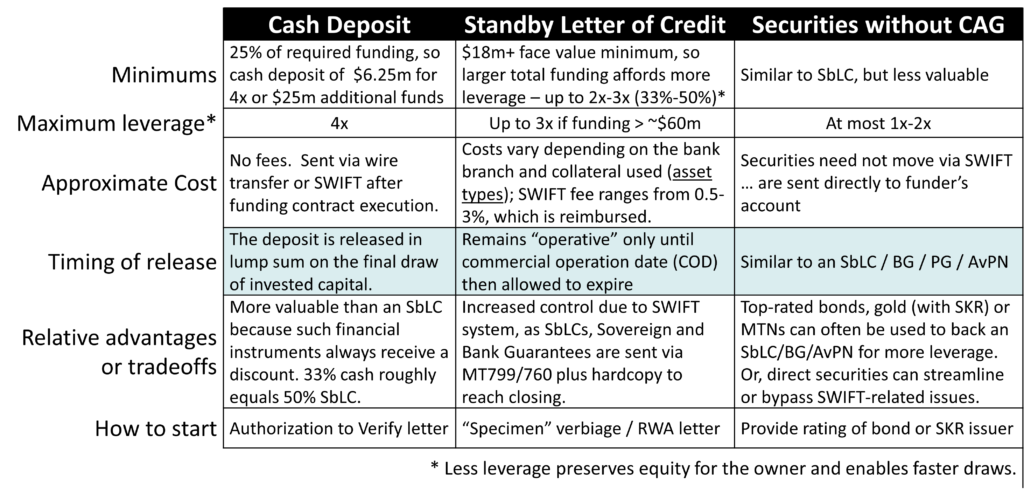
For SbLCs, or other bank-issued instruments (Performance/Payment or Bank Guarantees, etc.), the acceptability of assets as SbLC collateral, or just a balance sheet (non-collateralized), is entirely up to the involved banker(s). Bank policies and practices vary widely in this regard — some bankers will be fine with any of the seven main types of non-cash assets (or if the applicant’s balance sheet shows sufficient depth, no collateral assets whatsoever), while others are more particular about an asset’s ownership history (chain of custody), how title is held, ratings, or credit quality.
Note that even specific bankers within a given institution will give varied answers compared to their colleagues. One banker’s view of the SbLC could be that it must be backed by cash on deposit due to that particular banker’s work history in Trade Finance, where the seller of goods or services gets paid by the SbLC upon successful completion of the international transaction, which bears little or no resemblance to how we are using an SbLC for Project Finance security. Know more. Short version: nobody is “crazy” … more that some personalities have a hard time unlearning what they know to be true without any shadow of doubt, even if said knowledge doesn’t happen to apply here.
Recommend that you or your sponsor propose to the involved banker whatever assets or evidence of creditworthiness happens to be available and ask for feedback. Get specific, … offer basic KYC info when you inquire about what size (“face value”) SbLC would be possible with a given asset or company balance sheet (share summary of an audited financial statement or valuation, if possible). Remember that a bank’s KYC comes into play early, so better to ask a banker you know, even if not at one of the top-rated “Tier 1” US or global banks.
Still, don’t necessarily accept the first “no” or what seems at first to be an unreasonable requirement. Things are often not as they appear. Ask someone else?
If you plan to involve a third party “provider”
Rule #1: only work with a third-party source you know and trust. Then and only then would you want to discuss and consider the above factors to weigh a decision about what type of Security, amount of coverage/leverage, cost and procedures that would work best for your situation.
Otherwise, rather than taking needless risks, first read this article carefully, as we start with how to detect some of the common scams. Below that, item #2 makes sure the right type of instrument is on the table (SbLCs have many uses), the importance of working with complete information, and how some cultures and banking systems are just incompatible with ours, and what a bank instrument like an SbLC could cost versus the other available options.
Let’s start with the telltale signs that you could be wasting time trying to finesse or engineer a usable instrument that is just not going to be forthcoming:
- First, eliminate any “providers” (leased or purchased instruments) that are set on charging initial fees before delivering the guarantee instrument. Paying “decent money” for a usable guarantee from funding proceeds is fine, but unless you know the party personally, or know someone that does (with accountability to mitigate your risk), and can thus be certain they will do what they promise, paying ahead of instrument delivery is a bad idea because it could very well be a fee scam. There is no recourse if they just fail to act.
Also avoid anyone that:
(a) Uses any bank that does not have a reputation for delivering what they promise, or is unlicensed. There are over a dozen such banks in the world (probably many more) that might seem like a bargain, but the offered instrument is basically worthless. Not sure? Request the password to this list.
(b) Claims that MT799 or MT199 SWIFT will transfer or “block” funds, or otherwise deliver an instrument that, by itself, deserves payment at any time in the process. Only MT760 serves this purpose for an SbLC or similar instrument types. By itself, MT799 and MT199 provide secure, bank-to-bank, free form text messaging. It is important to understand that banks use such messages to advise, prepare, instruct or confirm, called “pre-advice”. That’s all. - Check if there’s alignment on the Type/Purpose of the Guarantee: The party backing or authorizing the guarantee may not recognize that it is to be used for PROJECT FUNDING, so often the reason they insist on certain wording is to protect their interests (with quite different risk exposure than In3CAP project funding), or they will attempt to negate or offset their perceived risk by dragging their feet, using impractical procedures, or asking for the moon, and/or in an effort to avoid making a mistake they will simply say “no” or make up a story about why they cannot deliver what they assume you are asking. SbLCs are like multi-purpose Swiss Army Knives and can be used for so many things, it helps to explain that it is not for trade finance (monetized to pay the seller) but instead as security for PROJECT FINANCE and allowed to expire once the project reaches Commercial Operation Date (COD). So, if this intended purpose is not clear, any refusal or foot-dragging will have no particular meaning.
Watch out for the following examples to avoid misunderstandings:
(a) The guarantor or provider might assume the transaction is for trade finance (where a Standby or Documentary LC gets cashed to complete a trade transaction). We do not intend to cash the instrument to pay the seller. Here, with CAP funding, we only want the services of the SBLC for a limited time (until COD), then it is released — technically, it is allowed to expire.
(b) Another example is when an involved vendor (EPC/GC/OEM) assumes the funding hinges on a type of performance bond or insurance. None of our Security options are this, and thus unlikely to result in a usable bank-involved instrument because either the involved vendor wants to use far too small a guarantee (just their budget responsibility, or traditional offer of “bonding” at 10%) relative to the total funding. Per the chart above, this often allows at most ~3x funding for an SBLC (33% coverage), which is probably not workable. Sometimes an offered incentive like modest equity carried interest will help to align interests with the vendor, providing some “skin in the game” to increase the guarantee size so that it works for all parties.
c) If the sponsor does not truly have the financial capacity to make such sponsorship work, because they are new, or too small, lacking sufficient available assets, balance sheet depth, or credit rating.
In addition, we cannot use any type of insurance product as a financial, bank-involved guarantee.
More on this point at in3capital.net/success-tips/#insurance - Is crucial information missing? How can the parties agree to this instrument with so many unknowns? Qualifying CAP funding clients eventually receive binding terms as part of an Investment Agreement that governs the use of the Security. This agreement will be entered and available before financial closing, which is before the Security is committed. But at the start, the involved sponsor or banker(s) have not yet seen that all-important document, which tailored to each unique investment, so they can get stuck with making up a story (imagination tends toward negativity, even in healthy human brains) instead of asking for clarification of the facts.
This situation — missing information — is often solved by explaining to others that CAP funding uses a 2-stage “pre-qualification” process – (1) First stage lines up a feasible funding transaction, using a “specimen” or sample of the actual instrument (defining all the essential elements), or other verification steps (see “how to start” in the chart above), then (2) Once the proposed Security has been accepted, the client will be informed of the results of Due Diligence, and if all goes well, we make an offer such as via a term sheet or the actual funding contract, which gets arranged by respective legal counsel. The signed and notarized Investment Agreement can be shared with the issuing or endorsing bank, and if Security involves a financial instrument like an SbLC, the issuing bank would assign a tracking code to accompany SbLC delivery.
This 2-stage process also serves as a personality test: some bankers simply won’t have the patience to approach this as 1) test, 2) go. They want to skip a step and discover all the facts up front. Only when the party is willing to listen and learn how conditions are a bit different than what’s most familiar to them (letting in some new information, if unfamiliar with “standby” or “demand” guarantees used for project finance, such as addressed in In3’s FAQs on this topic) … then and only then, aware of how this private funding works, will they come to the conclusion that the instrument is at once industry standard (within Private Banking, at least), balanced and reasonably safe. Ask for further proof on this point, if required, in the form of independent legal review, for example. Otherwise, bankers sometimes flunk this personality test, and it simply won’t work to try and try harder to “convince a mule.” With the proper appeal, and respect for how it may be new and different than what they expected, we have seen most sponsors and bankers get comfortable to take next steps. - Not every culture is going to be compatible for bank-involved instruments: Although we have few restrictions based on countries where we can do business, the issuing bank’s culture (branch location more than the bank’s parent/headquarters) can have a strong influence on guarantee wording, presumptions about acceptable underlying assets, and thus basic compatibility. For example, guarantees from Chinese banks with branches situated within mainland China cannot make our guarantees work, history shows. Of course, the US and other countries have sanctions in place for Russia, N. Korea and presently Venezuela, so eliminate those, too. Save yourself time by recognizing when there is such an engrained and immovable obstacle. But that said, it is not a requirement that the sending bank (establishing an account for the project’s SPV) be located in the same country as the project. Guarantees never need to be from the same country as the project itself.
- Financial feasibility: Guarantee fees are on an annual basis, typically, although renewal of a guarantee usually costs less than the initial cost to deliver it. Third party guarantees where a “provider” delivers the guarantee as a service are even more expensive, where fees can add up. Look at the project’s IRR to reckon with this: can the project afford a more expensive guarantee or should an entirely different approach be used? Some project owners — especially those already established with at least one operating project — can use 25% or more cash instead of bank-involved guarantee, or registered/rated bonds, Medium-Term Notes (MTNs), gold with top-rated Safe Keeping Record (SKR), or other forms of security. Compare
- Begin with a simple test to determine feasibility: Start with In3’s template (“specimen” or example of what works) and ask if the banker(s) can agree to something close to that language, with any revisions needed redlined, filling in the basic facts such as the proposed face value in US$ or Euros, the name and location of the issuing bank, the proposed maturity date (365+1 days, a bank year, is standard), and then have that routed to In3 or your Affiliate for review.
Usually, if there’s a will, there’s a way, but some of these points are subtle, adopted from In3’s “Practitioner Series” where Registered Affiliates and Regional Practice Managers are trained to recognize these and other signs. Quick Guide to CAP funding Guarantees.
To explore further:
- Guide to communicating with bankers for their part in the CAP guarantee.
- CAP Frequently Asked Questions on guarantees
- In3’s premium “Done For You” Service
- Ask a question of your own or make a customer service inquiry here.