

Guide to CAP funding Guarantees: How to Obtain One
What it is? A Completion Assurance Guarantee is a bank-involved, financial guarantee, mainly as a bank’s Standby Letter of Credit (SbLC), sent via SWIFT, which stays in place as security until project delivery. The advantage is that it de-risks to make funding much easier.
Project delivery occurs once all the funding has been received and the project has been completed to the best of the development team’s ability, whether or not on time and within budget, so that the authority with jurisdiction grants an operating permit, and the project can be commissioned to begin commercial operation.
Unlike traditional loans from institutions that require “credit enhancement,” such as a loan guarantee, corporate guarantee and/or collateral liens, transferring risk of loan default to the guarantor, we do none of that. What sets us apart from traditional project funding:
| Traditional Project Funding (mainly bank loans — not In3 CAP) | CAP Funding |
| Project status is ready to build, with all permits, the site secured, all development costs paid for, no technology risk, credit risk or execution risk. Comprehensive insurance. | We can fund at any reasonable stage of readiness, and do not object to paying for remaining development costs. Insurance not required. |
| Another party (if not the project owner directly) must take on a meaningful share of the risks. 100% funding from a single source is not allowed. | 100% funding is fine; CAP seeks short-term security to filter out fraud. Security is released upon reaching Commercial Operation Date (COD). |
| US$ or Euro currency only, usually in the developed world, with no political risk. | Any major currency is fine; we can accept the hedging risk. Global reach. |
| Loan guarantee and collateral or UCC-1 lien for the life of the loan. This is effectively a co-signer or “backstop” to prevent loan default. | No loan guarantee, no collateral lien, just funding — minority equity without charging interest or the need for control. Completion security protects both parties interests. |
| Project management teams must have long history of developing and building similar projects in the same country or region. 3-5 years minimum track record, or everything else gets put under a microscope. No technology or commercial risk whatsoever. | We accept new teams working with innovative solutions. First-of-a-kind breakthrough technology, or other innovations are particularly welcome they help achieve social and/or environmental goals, AKA “triple bottom line” benefits. |
Traditional project funders include commercial banks, institutional lenders such as from government programs, or Development Finance Institutions (World Bank IFC, US DFC, regional development banks, etc.), or any other investor that uses traditional criteria. Most require substantial owner “skin in the game” (new money plus evidence that the project is completely “shovel ready”) from the developer’s side, comprehensive insurance, Debt Service Coverage Ratio (DSCR) above 1.5 or IRRs in the mid-teens or higher. Not so for In3 CAP (see also “quick read” of In3 CAP funding Benefits & Advantages).
Why this innovative approach? Our private Family Office (FO) partner is effectively the developer of record in the eyes of the funding bank. Our FO uses established credit facilities plus holdings to fund client projects, where the bank requires that the parties work together to finish the project asset; nobody gets to “run away” with funds. We have found that this structure effectively filters out fraud. If you are not fraudulent, then this option will yield strong advantages.
CAP funding allows easier access to project capital, up to 100% of the budget, at virtually any stage of readiness, as a Joint Venture equity partnership (no loan, no interest expense) thanks to this in-house funder’s long history of successfully delivering advantageous funding for diverse projects globally.
There are mutual protections making it practical and easy to access funds for qualifying projects (more). We work in steps or stages, which can flow quickly, starting with any necessary confidentiality, basic discovery, and a simple method of showing you or a sponsor has capacity for some form of Completion Security Deposit.
How much leverage can be used?
The main CAP guarantees can be substantially leveraged — they’re not 1:1 with the project’s required funding. A cash surety deposit can be leveraged the most, followed by a bank-issued instrument such as a Standby LC offering the next-most efficient approach (compare these two popular options — CDS versus SbLC). Expedited SbLC steps.
Here is a comparison of the maximum amount of leverage you can use with the various types of CAP funding security:
| Cash Deposit** | Standby Letter of Credit | Direct Securities (without SbLC) | |
| Minimums | 25-35% of required funding, so cash deposit of ~$8m for 3x that secures $25m total project funding* | $18m+ face value minimum, so larger total funding affords more leverage – up to 2x-3x (33%-70%)** | Similar to SbLC, but less valuable |
| Maximum leverage* | Up to 3-4x | 1.5x up to 3x if funding > ~$60m | At most 1-1.5x |
| Approximate Cost | Nominal fee for cash-on-hand sent via wire transfer, or via SWIFT, to custodial account as last step before closing, once all contracts are signed and notarized. | Costs vary depending on the bank branch and collateral used (asset types); SWIFT fee ranges from 0.5-3%, which is reimbursed. | Securities need not move via SWIFT (are hypothecated) … sent directly to funder’s brokerage account. |
| Timing of release | The deposit is released in lump sum on the final draw of invested capital. | Remains “operative” only until commercial operation date (COD) then allowed to expire | Similar to an SbLC / BG / PG or AvPN |
| Relative advantages or tradeoffs | More valuable than an SbLC because such financial instruments always receive a discount. 33% cash roughly equals 50% SbLC. | Increased control due to SWIFT system, as SbLCs, Sovereign and Bank Guarantees are sent via MT799/760 plus hardcopy to reach closing. | Top-rated bonds, gold (with SKR) or MTNs can often be used to back an SbLC/BG/AvPN for more leverage. However, direct securities can streamline or bypass SWIFT-related issues. |
| How to start | Authorization to Verify letter | “Specimen” verbiage / RWA letter | Provide rating of bond or SKR issuer |
| * Temporarily offering a minimum of $15m or more funding with at least 35% cash surety deposit ($5.25m until final draw of ~3x capital). ** Less leverage preserves equity for the project owner and enables faster drawdown of invested proceeds. *** Cash deposit (not a payment) for up to 100% financing can come from the developer’s resources, a sponsor, bridge lender (short-term use works out better than using long-term project debt at current rates), or ground leasing. | |||
How to start: Propose an SbLC based on our wording template with any of these assets used as collateral (or without collateral, with sufficient balance sheet strength) for the SbLC-issuing bank, or propose any of the following potentially viable but less common forms:
- As a Sovereign Guarantee (SG) still involves a bank to confirm it
- Direct transfer of registered/rated Bonds, Medium-term Notes (MTNs), Gold with Safe Keeping Receipt (SKR), or Public Equities — no SWIFT needed (compare & decide)
- Avalized Promissory Note (AvPN), where a bank “stamps” or endorses it (URDG 758 only), hardcopy only (no SWIFT). Avals are more widely available from banks based in Europe or Asia than the US.
- Bank Guarantee, Performance Guarantee or Payment Guarantee (BG/PG) if it uses the SbLC wording.
All of the above are “hypothecated” forms of short-term security deposits — instead of an SbLC. By comparison, SbLCs or cash are more widely used — with further practical tips on how to obtain and use them shown below.
 What is the Security Deposit used for? We offer flexible, mid-market “impact” project capital using an innovative, flexible structure. Compared to the traditional route, CAP funding has strong advantages, such as streamlined due diligence, less stringent requirements for stage of readiness, or owner cash equity “skin in the game.” This novel approach delivers more predictable and faster closings for receiving the first draw of funds. More at Why is Security needed? or When CAP could be your best or only option for project finance.
The purpose of the guarantee is as security for project construction and delivery, outlined here in our FAQs. Any of the above assets or securities can be usable as collateral for a Completion Security Deposit (CSD); minimums apply.
Summary of asset types that can be used or pledged as collateral for a suitable guarantee.
Simple steps to securing a Completion Security Deposit (CSD)
What are the options for a CSD? ~25%-35% or more cash can be used as a deposit, which stays in place just until the final monthly draw of funding, at which time it is released in lump sum.
Compare SbLCs to Cash Surety Deposits: Most of our clients prefer the SbLC approach as it is asset-backed, instead of moving cash. Some, however, prefer cash or direct securities, such as a usable bond/MTN/gold … because their bank (or sometimes just the involved bankers) have a hard time understanding or accepting the safety of the SbLC / SG / BG / PG or Aval endorsement. A middle ground is to qualify for the bank’s Line of Credit (LOC), so they are comfortable that they won’t end up looking bad, even though in practice we won’t need to call the instrument. They still look at worst case scenario, however remote the odds of that happening, and won’t get fired for saying “no” right away.
Recent examples of bankers who agree to this LOC approach include lower fees (they may charge a “facility fee” or “administrative fee” to establish the LOC), but then charge close to nothing for a Standby LC issued against it. The LOC just sits there, like the SbLC — no funds need to be drawn into a cash account and thus no interest expense.
If the SbLC wording is not agreeable, then you can at least pivot to a cash surety deposit (often using less of the line than would have been committed to back the SbLC) and the short-term interest charged by the bank for the line still makes this package financially attractive — any interest expense can be amortized over the life of the project, and thus barely affects the overall project IRR.
SbLC wording that complies with established rules and our partner’s funding bank requirements may seem out of reach, and you might not want to know more about this wording and the intricacies of governing rules, how some bankers assume (incorrectly) that cash must be used as collateral (due to the notorious misnomer/misinterpretation of the phrase “cash backed”), and other guarantee sourcing tips.
When is CAP funding your best (or only) option for project finance?
Getting Started: First step is to simply ask the involved banker — preferably the one that knows the guarantee’s asset owner or agent — for a “specimen” (unsigned) SbLC based on our SbLC template. This saves a lot of time, as we can usually offer a fast yes/no signal and if “no” explain why.
We’re most likely going to accept a proposed SbLC that mirrors our standard verbiage, although there is room for variations in format or layout, so long as the main provisions are included, with nothing extra added that would negate those provisions. See below. If you are not sure, ask your In3 Affiliate or In3’s client relations to review the verbiage once we know and have accepted the proposed project sector, budget, and location.
Further tips:
- In addition to a Standby LC (SbLC), here are some helpful points about the alternative CSD types:
- Bank-confirmed Sovereign Guarantee (SG) from the Finance Ministry. If you are working in a country that can issue an SG, usually without cost, explore that further here.
- Bank Guarantee (BG) if to be used outside the US — BGs are not allowed in the US, which happens to be where our preferred funding banks are located, so only arrange a BG once making sure an SbLC is not going to be available. Cash is probably better than a BG, because we would have to work with a subsidiary to fund your project, which we can do. In any case, to be usable, a BG must largely conform to the same wording as shown in the SbLC template.
- Performance Guarantee or Payment Guarantee (PG), similar to a BG, so long as it largely conforms to the same wording as shown in the SbLC template. A few more details:
- Payment Guarantees can work, again with the same wording as an SbLC, but not “Advance Payment Guarantee” (APG), as the latter implies payment before the project’s funding is secured (a conundrum), so that title doesn’t work.
- Blocked Funds can also work, though this usually offers less protection for the issuer, as it is more freely callable.
- Avalized Promissory Note (AvPN) is a bank-endorsed or stamped (with “per aval”) Commerical Promissory Note (PN), with available templates for both the PN and a non-binding RWA letter used to begin the approval process. Best understood by bankers in Europe, the Aval is not as common in North America or other markets.
- Direct (issued by the owner directly to our Family Office’s account in lieu of any of the above guarantee instruments):
- Medium-Term Notes (MTNs) have long been a reliable method for raising capital, particularly for established companies or in cooperation with those with financial depth (what we can “sponsors”). MTNs are flexible, often cost-effective (especially so compare to traditional financing methods), and can come from diverse sponsors, solving the challenge of bringing the necessary security without having to learn the intricacies of SbLCs, allowing developers to mainly focus on their core business activities.
- Gold with Safe Keeping Receipt (SKR) — SKRs are financial documents issued by banks or financial institutions that certify the ownership and safe storage of the assets.
- ISIN-registered and rated bonds whether private/corporate or public, such as US Treasuries (but not a “bond” in the sense of insurance products). The ISIN number must be assigned, but the bond must also be top rated.
Compare and decide which type of CSD is right for your situation
The rest of the article focuses on HOW TO ARRANGE A CAP FUNDING GUARANTEE, starting with a synopsis of what project owners can do to secure their own guarantee, followed by a list of alternative options, whether for individual projects, a series of projects, or an entire portfolio.
SYNOPSIS: For owners/developers or project fundraisers …
- With assets that can be used for a collateral pledge to a bank, or gain the bankers’ endorsement with our alternative guarantee, follow our 3-step process, outlined below, starting with a draft of the proposed instrument, then register your project and upload the basic materials along with any questions.
- For owners/developers that have few or no available assets, the first step in this process serves as a feasibility test — requesting a draft financial instrument such as an SbLC from any bank (be sure the involved bank or provider is legitimate) gets your sponsor’s draft guarantee on the table.
Send the proposed instrument to In3 via Email after making sure your project’s budget and overall purpose are in our wheelhouse. The right bankers on your side, yours or a sponsor’s, will understand your request when you share our template of standardized instrument “verbiage” (wording).
The bigger picture includes just two additional items — so 3 things total — to enable this streamlined pre-qualification:
- A draft guarantee (based on our template), which can be leveraged somewhat, used to assure project completion. This template is standard language for either a “Standby” Letter of Credit (SbLC), or if outside the US, perhaps a Performance Guarantee or Bank Guarantee (BG) is the only option, sent via customary Brussels SWIFT, or one of the others types listed above.
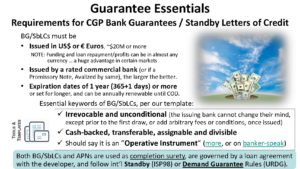
Complete list of Completion Assurance Guarantee options:
- Standby Letter of Credit (SbLC or SLOC) is the most widely used, and much preferred for the best terms.
- In certain countries, a Sovereign Guarantee (SG) from the Ministry of Finance can be issued if the SG can be confirmed by a local bank.
- Bank Guarantee (BG), the most common; can also be entitled a Payment Guarantee or Performance Guarantee (PG, but not an Advance Payment Guarantee) so long as it otherwise adheres to our standard SbLC verbiage.
- ISIN-registered and preferably top-rated Corporate Bond or MTN (types of securities, not insurance products). These are much less common.
- Alternative if BG/SbLC is problematic from your bank: a private company-issued commercial Promissory Note endorsed with a bank’s “Aval” (AvPN).
- Minimum 25%-35% or more cash surety deposit instead of any of the above is also acceptable.
- An RWA letter or similar if a bank-involved instrument, then (once approved) a signed Authorization to Verify (ATV) letter sent to In3 via Email. An RWA letter would be from the involved banker(s) stating their intention to issue, endorse or confirm the proposed guarantee – any of 3 types. RWA stands for Ready, Willing and Able and is the bank’s letter of intent. An ATV letter is from the account holder known to the banker that will be used to show capacity, verifying that the involved banker is on board with the proposed security deposit to be delivered once the funding contract is in place.
- We provide free guidance on what will work, and what’s preferable, but you get to explore possible arrangements for delivering the security deposit (whether as cash or an asset-backed financial instrument) involving the bank you prefer. The actual security deposit is not sent until the project’s funding is under contract, with commercial terms discoverable by the involved bank (they may want to issue a tracking code), as the last step before financial closing. Closing is what unlocks your funding per the established draw schedule.
The monthly funding draw schedule, based on consistent (or increasing) cash requirements to reach “Commercial Operation Date” (COD) — is at least 12-18 months, typically, and with enough security deposit can be entirely drawn down in the first year. Remember that this is equity funding, not interest-bearing debt, as a JV/equity partnership, and mainly for constructing something — either a new “greenfield” project, retrofit, refurbishment, or expansion. The guarantee or cash sits as security until construction has been completed and project(s) commissioned to begin commercial operation. See example of how to structure a Monthly Draw Schedule on page 3 of this PDF.
In practice, any bank will do (low rated, unrated but authorized/licensed commercial banks, even smaller credit unions in the US would work), but we recommend starting with any bank that has already done its KYC on the party requesting the security/guarantee — where there is an established account or other relationship with the bank. A customer of the bank will usually get a faster and more measured response, saving time.
To request a guarantee, the account holder contacts the bank and fills out their application that identifies the face value amount and purpose of the security deposit. Typical applications stipulate a specific period of time for which the guarantee should be valid, any special conditions (explain that its use will be governed by our investment agreement, which they will receive and evaluate before being asked to provide the security) and that In3’s capital partner, a US-based Family Office, is the final Beneficiary.
So long as the banker is aware this is for project finance, not trade finance, they will not normally expect a bank-involved guarantee (such as the Standby Letter of Credit) to be backed by cash on deposit. If you had cash, you could use that directly (compare), and gain greater advantage because cash is more efficient. Most commercial bankers will understand these instruments, and play along (if not, read Communicating with Bankers so you are prepared to steer them in the right direction), and instead of saying “no,” exactly, they will offer unreasonable terms, such as a SWIFT fee of more than ~2% and/or the need for a loan from the bank to have cash on deposit. Bankers sometimes throw obstacles in the path to see if you are committed.
Note that larger banks typically have multiple divisions, so make sure you are talking to the right one — NOT the “trade” division, but instead the people that handle private banking, or wealth management. You will be better understood within private/wealth management divisions, and avoid considerable head-scratching and confusion, due to inherent silos most larger banks have; confused banker rarely do what you ask.
In other words, within bigger banks (so-called “Tier 1”), you may have to find the right bankers … then the above checkpoints get satisfied more quickly and then we complete due diligence within just a few weeks. If all goes well, you will negotiate and sign the funding contracts within ~30 days.
Be sure to request In3’s presentation materials for sponsors, or see what assets (besides cash) can be used to secure a CAP security deposit.
Not sure if In3 CAP funding is right for you? Consider these conditions when In3 CAP is your best or only option.
Financial Guarantee Options
To assist with Doing It Yourself (DIY), outlined above, here is advanced “how to” information to succeed with guarantees using your knowledge, network, and drive. This is the only option presently available without additional costs.
Second, there is a quick service that would enable owners/developers and their agents/sponsors/promoters to pinpoint the best option(s) for securing a guarantee, largely based on the bespoke merits of the project or portfolio of projects seeking funding. More
Finally, be sure to review our Standby LC (the main form of guarantee) Sourcing Tips.