Development Finance — strategies for impact & sustainability
Inspire | Innovate | Invest
Development Finance — strategies for impact & sustainability
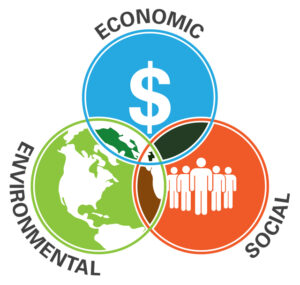
To achieve our mission and purpose, for nearly 30 years we have taken a “triple bottom line” approach, partnered with private funders focused on social/environmental impacts alongside financial returns, sometimes called “blended value.” Roughly one third of our collective portfolio can be impacts-first oriented investments. Making a profit is essential to sustain the social/environmental benefits, but not sufficient, per our investment strategy. Blending the two — social/environmental benefits with financial upside — has become increasingly important (and at times, popular) in today’s economy, with a world full of pressing problems.
The Human Thing To Do
Those seeking investments for the sake of “development” often actually mean what others call “sustainable development” an important facet of “impact finance,” which must not overlook the social side. Translation: helping people gain autonomy, self-sufficiency, the ability to meet their own needs over time … a core imperative, sometimes handled (paradoxically) more like an imposition, rather than an invitation, which must be in consultation with the humans who are to receive said benefits. The premise is born of empathy and humility — drive toward solutions once there is human connection and a baseline of mutual respect and skill to improve both “incomes and outcomes” for all stakeholders. Cutting-edge regenerative design principles apply to humans, such as this form of inclusion, making the ecosystemic stakeholder voices the driving forces used in making critical decisions. Although regenerative philosophy is most often applied to food systems, sometimes this view of governance and sustainability by design can compensate for years of elitism and privilege. Suspending the ordinary power structures (hierarchies), and the privileges that are derived from it, at least temporarily, during decision-making cycles, can get better results, in an effort to, as we state above, “improve incomes and outcomes.” This form of “impact capitalism” is sharply different from aid or philanthropy, both of which have their place in the continuum of funding that many communities need to succeed on their own. That just means that, in the interest of fairness and social “equity”, due compensation can be necessary to reach socially just and truly sustainable outcomes. For example, if the developed world has caused displacement or job loss due to a rapidly changing climate (crops that once thrived in a given region that prove no longer viable, or weather patterns that adversely affect water cycles), or job disruption due to the rapid proliferation of AI technology, or misguided aspects of the current US “America First” national agenda… In3 represents and promotes reliable, apolitical, long-term solutions. We firmly believe that combining financial returns with positive social and environmental impacts, both in emerging and developed markets, builds momentum. Even when the financial returns are below market rates, diversity in our investment portfolio gets more important things accomplished in this world than would be if we were greedy about maximizing financial returns through shorter-term objectives. We’re in it for the long haul, in many areas aligned with the UN Sustainable Development Goals (SDGs) so that by 2030 and beyond we have made serious and measurable progress in the areas that matter most. Investors, including us, are social animals that are greatly influenced by patterns of success (sometimes to a fault, akin to a “herd” mentality) but for different reasons we all want to reach scale, so we are interested in developers that have scalable business plans, capable of working with us toward success at the UN SDGs while there’s still time. But the developing world (including emerging and frontier markets) has unique challenges and opportunities that sets it apart from the more developed countries, such as the aforementioned self-sufficiency, but also the potential for solving unique problems due to lack of infrastructure (such as rail or roads), housing, reliable electricity, in some countries limited healthcare, water and food security, and so on. One classic definition of Development Financing (from the Asia-Pacific region): “… providing access to financial and support services for the underserved, the strategic and priority areas of a country in order to achieve sustainable growth of the economy and thereby assure a more equitable distribution of the benefits of progress and a better quality of life for its people.” [source] In3 and countless others have, since 2019, invested at the intersection of the low-carbon or “circular” economy, sustainable infrastructure, and climate change mitigation, which ties back to health and prosperity in a different set of ways. In3 Capital Group offers tailored and bespoke impact funding solutions, as well as advisory and co-development services to ensure successful closing, sooner, making such capital accessible and affordable to the widest possible circle. See our Solutions Center.


 To achieve our mission and purpose, for nearly 30 years we have taken a “triple bottom line” approach, partnered with private funders focused on social/environmental impacts alongside financial returns, sometimes called “blended value.” Roughly one third of our collective portfolio can be impacts-first oriented investments. Making a profit is essential to sustain the social/environmental benefits, but not sufficient, per our investment strategy. Blending the two — social/environmental benefits with financial upside — has become increasingly important (and at times, popular) in today’s economy, with a world full of pressing problems.